About Me

My photo
Bruce is dedicated helping managers become more strategic; get people out of silos and working with trust and cooperation; and develop leadership throughout the organisation. For you it's about reducing bureaucracy, opening communication and releasing energy in under-performing managers, staff and processes.

Tuesday, January 15, 2013

TO FUTURE-PROOF YOUR BUSINESS - MEASURE YOUR SUCCESS AS ITS CONTRIBUTION TO THE WELL-BEING OF LIFE

Business is entering a period of fundamental change. Very few organisations will survive. Those that do will have a different mindset including redefining their success as contribution to well-being of life.

Today most organisations define success by measuring profit and return on assets which are the result (not the cause) of yesterday's success. Given that what you measure is what you get, organisations need to redefine success by measuring things that will cause tomorrow's success. Things like health, knowledge, skills, wisdom, attitudes, hope in the future, absence of fear, relationships, respect, awareness, sense of purpose, beauty, self-control, freedom and happiness and environmental affects.


Can you imagine the success and longevity of an organisation that was truly successful in contributing to the well-being of life? This organisation would definitely be rewarded with profit and longevity well beyond 50 years.


Bruce Holland

TO FUTURE-PROOF YOUR BUSINESS - BUILD CO-CREATIVE PARTNERSHIPS WITH THE REST OF NATURE

Business is entering a period of fundamental change. Very few organisations will survive. Those that do will have a different mindsets including building co-creative partnership with the rest of nature.

There is no doubt that the rest of nature is in trouble. This is reflected in all major indicators like the ozone layer, climate change, water quality, air quality and species extinction.

Business has begun to be quite proactive in this. We see progress in triple-bottom line and the sustainability movement, and many organisations are already on-board and see green dollars as a major contribution to their profits. Despite this success, business has a long way to go.

Our resource base, planet earth, is shrinking while our population continues to expand; increasingly, cracks are appearing in the capacity of our communities, ecosystems, and landscapes to provide the goods and services that sustain our well-being. These intertwined systems are like a boat at sea, constantly confronted with surprise events such as storms. The degradation of these slow variables is reducing our "freeboard," our ability to survive these storms.

Can you imagine the success and longevity of an organisation that was truly successful in helping to solve these life-threatening issues? This organisation would definitely be rewarded with profit and longevity well beyond 50 years.


BRUCE HOLLAND.

IMAGINE IF MANAGERS BELIEVED THEY WERE MANAGING A NETWORK

Managers need to change the story they tell from: “We are managing an organisational tree” to “We are managing a series of interconnected networks.”

If you tell a story about managing an organisational tree, it makes sense to be on top, hierarchical and dominating. However if you tell a story about managing a network it makes no sense to manage in this way; either inside or outside the organisation.

Networks demand a completely different way of managing , based on network science and the laws of networks.

Bruce Holland

Monday, January 14, 2013

IMAGINE IF MANAGERS KNEW WE WERE DEEPLY CONNECTED RATHER THAN SEPARATE

The stories we tell create our reality. 

Imagine if our managers knew the story that physicists have known for 50 years. Previously their story had been to see their science as the study of physical materials like solids, liquids and gases. Their new story is to see it as the study of how things are organised and relate to each other.

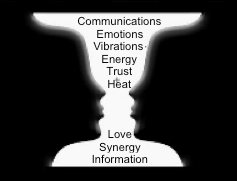
In business, we need to learn this story. Most managers spend most of their time focused on the individuals within their organisation (Peter, John and Mary). In the first chart they would be looking at separation and seeing the two faces


If our story was about connectedness, as managers we would know that it is the space in between people that makes the most difference. Instead of seeing emptiness between people, we’d see the vase. We‘d see emotions, heat, vibrations, energy, trust, information, communication, synergy and love. Our job under this story is to fill the vase to the top with these things. In essence it is a move from product-centric to relationship-centric thinking. It’s from win-lose to win-win.

Regards
Bruce Holland

Tuesday, December 11, 2012

IMAGINE IF MANAGERS BELIEVED THE MOST IMPORTANT THINGS IN BUSINESS WERE PLENTIFUL

The stories we tell create our reality.

Managers need to change the story they tell from: “We live in a world of scarcity” to “The most important things are plentiful.”

We need a new business model: one that does not depend on continuing economic growth. Fortunately this model already exists: it’s one that’s based on things that make us happy rather than things that make us miserable. I’m thinking of ideas, relationships, trust, and communication; all things that are plentiful and become even more valuable as they are used.  I’m convinced we can future-proof our organisations for the next 50 years but only those who adopt this story.

BRUCE HOLLAND

Sunday, December 9, 2012

IMAGINE IF MANAGER'S KNEW THE BEST WAY TO BE STRONGER WAS TO GROW THEIR SRENGTHS NOT THEIR WEAKNESSES

The stories managers tell create their reality.

They need to change their story from: “To become strong I need to improve my weaknesses” to “To become strong I need to grow my strengths”

Of all the business stories I’ve tried to change over the years this is the one that’s probably received the most “ahas.” It usually comes up when I’m introducing clients to Herrmann’s Brain Dominance Index. Our current story is really pervasive and quite stupid as I hoped the following story will show.

Steve Williams is talking to Tiger Woods: “Tiger I’m really pleased with the progress you’re making in your golf but your tennis is fairly weak. I want you to give up practicing golf for six months and concentrate on your tennis!”

BRUCE HOLLAND

Tuesday, September 18, 2012

IMAGINE IF MANAGERS BELIVED COLLABORATION WAS THE NATURAL ORDER RATHER THAN COMPETITION

The stories we tell create our reality.

Imagine if our managers knew the story biologists know: human beings evolved as small weak animals. To overcome this weakness we had the choice of two evolutionary tracks: either to grow bigger, or to multiple our size by collaborating with others. We chose the second track. It’s no wonder we are born to collaborate, it’s built into our DNA!

At the organisational level, many large mature workplaces suffer from cutthroat competition from within their organisation; knives in the back; dogs eating dogs; but, new research is showing that stepping on people isn't the best way to get ahead.

Because of our competition story, today we seem to sublimate much of our human nature in the workplace. What I find is power, ego, separation and fear dominating over care, love and cooperation. We need to listen, love, care and support each other. Today’s problems both in organisations and in the world are seldom technical, they are nearly all based on poor human relationships. It’s caused because our story is of competition whereas it should be collaboration.

The best story for competition is told when you are trying to improve yourself, not beat others.

Bruce Holland